
A SaaS AI SEO strategy works when keyword research maps to the buyer journey rather than search volume — TOFU, MOFU, and BOFU terms across a content cluster built to drive trial sign-ups, not pageviews.
A SaaS AI SEO strategy works when keyword research maps to the buyer journey rather than search volume — ranking problem-aware TOFU terms, use-case MOFU terms, and competitor-alternative BOFU terms across a content cluster architecture built to drive trial sign-ups, not pageviews. Pipeline attribution is the metric that separates high-performing SaaS SEO from activity-based reporting: every content cluster needs a GA4 conversion event tied to a trial or demo request, not a position tracker. With AI search engines like ChatGPT and Perplexity now intercepting SaaS buying decisions at the research stage, entity authority and structured data have become as important as ranking position — and the SaaS companies that dominate AI-generated answers are those that built topical authority before the shift.
What Makes SaaS AI SEO Different from Standard SEO?
SaaS AI SEO is a search strategy that aligns organic content with a subscription buyer journey — where the goal is trial sign-ups or demo requests, not single-session purchases. Volume-first keyword research fails SaaS because high-volume informational terms attract researchers, not trial-ready buyers. The subscription model means buyers research for weeks or months before committing, so content must serve every funnel stage simultaneously.
SaaS companies building or using AI tools face an additional ranking challenge: their product features must appear in AI-generated comparisons — ChatGPT, Perplexity, Google AI Overviews — alongside established brands, not only in blue-link results. SaaS companies that use pipeline-stage keyword mapping rank content that helps buyers compare tools before the trial decision.
Why Do Traditional Keyword Volume Metrics Fail SaaS Companies?
Traditional keyword volume metrics fail SaaS companies because search volume does not correlate with trial intent — a 10,000-monthly-search term can drive zero demo bookings if it targets researchers, not buyers. The 4 reasons volume-first keyword research produces low-pipeline content for SaaS are:
- Ranking high-volume informational terms attracts readers who will never activate a trial
- Inflating session counts in GA4 while MQL numbers stay flat creates false confidence in the SEO programme
- Relying on Ahrefs KD or GSC click estimates hides pipeline-negative keywords that look healthy by volume alone
- Generating 100-search niche BOFU terms that convert at 8× the rate of a 5,000-search broad TOFU term — a fact volume metrics will never surface
Pipeline-first keyword selection — not volume-first — is the single structural decision that separates a SaaS SEO strategy from a traffic strategy.
How Do AI Tools Change the SaaS Buyer’s Search Behaviour?
To understand how AI tools change SaaS buying behaviour, you need to recognise that buyers now use ChatGPT and Perplexity as research environments before they ever visit a vendor’s website. A buyer asking “best CRM for fintech startups” in ChatGPT receives a synthesised tool comparison, not a list of blue links. If a SaaS brand has no entity footprint in AI training data, it does not appear in that answer and the website visit never happens.
SaaS AI SEO must build both a ranking footprint (Google) and an entity footprint (AI citation signals) — these are not the same objective and require different optimisation actions. The key entity signals are schema markup, authoritative external mentions, brand search volume, and Wikidata or Wikipedia presence.
How Does AI Search Reshape the SaaS SEO Playbook?
To reshape the SaaS SEO playbook for AI search, you must set 3 measurable goals that track brand mentions in AI-generated answers alongside traditional ranking and traffic targets: increase organic search rankings and pipeline traffic, increase AI brand mentions and recommendations, and increase AI citation frequency across authoritative sources. Each goal requires a distinct measurement approach — GA4 conversion events for goal 1, monthly manual prompt testing for goal 2, and external mention tracking for goal 3.
AI models pull SaaS brand recommendations from entity associations in structured data, from brand mentions in authoritative editorial content, and from review aggregator ratings on G2, Capterra, and ProductHunt. SaaS companies that score strongly across all three signal types become the default recommendation when AI models answer generic category queries.
What Are the 3 Goals of SaaS AI SEO in 2026?
The 3 goals of SaaS AI SEO in 2026 are organic pipeline growth, AI brand recommendation frequency, and AI citation authority — each requiring a different measurement instrument.
- Organic pipeline growth — measured by trial sign-ups and demo bookings attributed to organic sessions in GA4 conversion reports, not by keyword rankings or click counts
- AI brand recommendation frequency — tracked by submitting 10 target buyer queries to ChatGPT and Perplexity monthly (e.g. “best AI CRM for B2B SaaS fintech”) and logging whether the brand name appears in the generated answer
- AI citation authority — measured by counting authoritative external sources that mention the brand name in indexable content: G2 profile, editorial coverage, Capterra listing, partner integration pages, and industry directory listings
Setting all 3 goals before building the content strategy ensures the editorial calendar serves both Google’s ranking algorithm and AI models’ recommendation logic — which operate on different input signals and are no longer interchangeable.
How Do AI Models Decide Which SaaS Tools to Recommend?
AI models recommend SaaS tools based on entity association density — how strongly a brand is connected to a specific category, use case, or outcome across all the sources the model has indexed. AI models are not ranking engines — they synthesise brand associations from indexed sources, weighted by source authority. The 5 signals AI models use to surface SaaS brand recommendations are:
- Named entity frequency in category-specific editorial content, such as mentions in “best fintech CRM” articles on authoritative industry blogs
- Review aggregator ratings on G2, Capterra, and ProductHunt — AI models draw on these as structured third-party validation data
- Integration partner pages that explicitly name the tool, such as Zapier, Salesforce AppExchange, or Make.com integration listings
- Wikipedia or Wikidata entity pages that establish a tool’s category classification and founding entity attributes
- Structured data markup (SoftwareApplication, Product, Organization schema) that explicitly states applicationCategory and targetAudience
A SaaS company that scores strongly across all 5 signals becomes the default recommendation for generic category queries — regardless of whether it holds the top Google ranking for those same terms.
How Do You Map SaaS SEO Keywords to the Buyer Journey?
To map SaaS SEO keywords to the buyer journey, you classify every target keyword into one of 3 pipeline stages — TOFU, MOFU, and BOFU — before assigning it to a content type, cluster, or landing page. Search volume is used only as a tiebreaker after pipeline stage classification, not as the primary filter.

| Stage | Keyword type | Example keywords | Content type | Pipeline signal |
|---|---|---|---|---|
| TOFU | Problem-aware informational | “what is ai crm”, “how to reduce churn saas” | Educational blog post, topic pillar | Email sign-up, resource download |
| MOFU | Category and use-case terms | “best ai crm for fintech”, “saas ai seo tools” | Comparison page, use-case landing page | Trial start, demo booking |
| BOFU | Competitor and alternative terms | “[Competitor] alternative”, “[Competitor] vs [Brand]” | Alternative page, head-to-head comparison | Direct trial conversion, sales contact |
| BOFU+ | Branded and integration terms | “[Brand] pricing”, “[Brand] + [integration name]” | Pricing page, integration page | Purchase intent, high MQL signal |
Volume is a tiebreaker only after stage classification — never the primary sort.
Which Keywords Drive Top-of-Funnel SaaS Awareness?
Top-of-funnel SaaS keywords target problem-aware buyers — searchers who recognise they have a workflow pain point but have not yet identified a category of software to solve it. The 4 TOFU keyword types that generate qualified SaaS awareness traffic are:
- Job-to-be-done queries: “how to [achieve outcome]” terms tied to the exact workflow the SaaS tool automates — the highest-quality TOFU traffic because the searcher already wants the outcome the product delivers
- Pain-point queries: “why does [process] fail” or “problems with [incumbent tool]” — high intent to evaluate alternatives, short conversion path from read to trial
- Industry-and-process queries: “[industry] + [process] + software or tools” — segments the traffic by vertical so the email opt-in can be personalised to the reader’s sector
- Definition and primer queries: “what is [category]” — captures early-stage researchers who convert weeks or months later but inflate brand familiarity before the MOFU decision
TOFU terms rarely convert directly — their role is to introduce the brand to problem-aware buyers early enough that the brand name is already familiar when the buyer reaches the MOFU evaluation stage.
What Competitor and Alternative Keywords Should a SaaS Company Target?
Competitor and alternative keywords are the highest-pipeline BOFU terms available to a SaaS company — because the searcher has already decided to switch tools and is evaluating candidates, not researching a category. Three types of BOFU competitor keywords are worth targeting: “[Competitor] alternative” (captures active switch intent), “[Competitor] vs [Brand]” (comparative evaluation stage, buyer has a shortlist), and “[Competitor] pricing” (price sensitivity signal, often precedes a switch decision). New SaaS brands with low domain authority can rank for these terms within 60–90 days because established brands rarely build strong comparison pages for their own product — they don’t want to legitimise the comparison.
A BOFU competitor page that converts must answer the comparison honestly with a named feature-by-feature table, include real G2 or Capterra rating comparisons, and end with a direct trial CTA. Pages that hedge the comparison or omit honest weaknesses convert poorly because the buyer already knows the competitor’s strengths and will distrust a one-sided take.
How Do You Prioritize Topic Clusters by Pipeline Potential, Not Volume?
To prioritize SaaS topic clusters by pipeline potential, you score each cluster on estimated trial conversion rate, competitive gap, and search demand — in that order — rather than sorting by monthly search volume. The 6-step process for pipeline-first cluster prioritisation is:
- Map every candidate keyword to a pipeline stage (TOFU, MOFU, or BOFU) — BOFU and niche MOFU keywords rank first, high-volume TOFU terms rank last for a new domain
- Estimate the trial conversion rate for each cluster based on intent signals — BOFU alternative pages typically convert at 3–8%, MOFU use-case pages at 0.5–2%, TOFU educational content at 0.05–0.2%
- Score the competitive gap — clusters where top-3 ranking pages are thin, missing FAQ coverage, lack structured data, or show no first-hand experience are winnable faster than clusters dominated by established category leaders
- Calculate the pipeline value estimate: (estimated monthly organic sessions) × (cluster trial conversion rate) × (trial-to-paid rate) × (average contract value)
- Rank all clusters by pipeline value score and sequence the content calendar from highest to lowest
- Reassess cluster priority quarterly — as domain authority grows, TOFU clusters become viable and worth scheduling into the second half of the 12-month plan
This scoring approach ensures the content calendar generates pipeline from month 1, not after a 12-month authority-building runway that produces traffic before the site can convert it.
What Does a Content Cluster Strategy Look Like for a SaaS AI Tool?
A SaaS AI content cluster is a topical authority structure built around one pillar page — the highest-pipeline category or use-case term — with 8–15 supporting articles covering every downstream TOFU and MOFU query in the same topic area. The pillar page targets the broadest, highest-intent keyword in the cluster; supporting articles cover TOFU problem-aware terms and MOFU use-case terms; internal links from supporting articles pass relevance signals into the pillar, increasing the pillar’s authority for the head keyword over time.
SaaS companies building AI-native tools must publish cluster content using the exact terminology AI models associate with the category — terms like “large language model”, “RAG pipeline”, “vector database”, and “context window” for an AI search tool — so the brand appears in AI-generated comparisons alongside established players. Documented industry case studies show SaaS AI fintech tools growing from a standing start to 60,000 monthly organic visits within 7 months using this exact content cluster methodology — among the fastest publicly documented results in this category.

How Do Product-Led Content and SEO Work Together?
Product-led content and SEO work together when every article demonstrates the tool’s capability inside the content itself — not only in a sidebar CTA or a generic free-trial banner at the bottom of the page. An article on “how to reduce SaaS churn” that includes a product screenshot, an embedded workflow example, or an interactive demo showing how the AI CRM automates the churn-reduction process converts TOFU readers into MOFU trial intent faster than any abstract “start your free trial” link.
Every supporting article in a cluster should include at least one product-specific reference: a named feature, a real workflow screenshot, or a before-and-after data example. The rule: if a supporting article could have been written by a company that does not make this specific product, it is not product-led content, and it will not move the reader toward a trial.
What Is the Difference Between TOFU, MOFU, and BOFU Content for a SaaS AI Company?
The key difference between TOFU, MOFU, and BOFU content for a SaaS AI company is conversion depth — each funnel stage serves a buyer who is closer to a trial decision and requires a different content format, primary CTA, and success metric.
| Funnel stage | Buyer awareness level | Content format | Primary CTA | Success metric |
|---|---|---|---|---|
| TOFU | Problem-aware, no tool awareness | Educational blog post, pillar guide | Email sign-up or resource download | Organic sessions, email opt-in rate, brand search volume lift |
| MOFU | Category-aware, actively evaluating tools | Comparison page, use-case landing page, webinar | Free trial start or demo booking | Trial start rate, demo booking rate, time-on-page |
| BOFU | Tool-aware, comparing specific vendors | Alternative page, pricing page, case study | Direct trial start or sales contact form | Trial-to-paid conversion rate, revenue attributed to organic |
A SaaS AI SEO strategy needs active content in all 3 funnel stages simultaneously — publishing TOFU content before MOFU pages exist is a sequencing mistake that delays pipeline generation by 3–6 months.
What Technical SEO Foundations Does a SaaS AI Company Need?
SaaS websites need 4 technical SEO foundations — fast Core Web Vitals, clean crawl architecture, schema markup, and secure HTTPS — before any content cluster investment produces measurable ranking gains. Without these foundations, Google indexes new content slowly, Lighthouse penalises the site on Core Web Vitals, and structured data signals reach AI models incompletely.
The 4 technical SEO foundations a SaaS AI company must establish before launching a content cluster are:
- Core Web Vitals: LCP under 2.5 seconds, CLS under 0.1, INP under 200ms — SaaS applications with heavy JavaScript frequently fail INP because client-side rendering defers interactivity until after the browser has parsed all scripts
- Crawl architecture: flat URL structure (max 3 clicks from homepage to any content page), canonical tags on all paginated or filtered app pages, and an XML sitemap submitted to Google Search Console within 48 hours of any new cluster page going live
- Structured data: SoftwareApplication and Organization schema on the homepage and core product pages — the primary signal AI models use to classify a SaaS tool by category and match it to buyer queries
- HTTPS and domain consolidation: no mixed content warnings, HSTS headers configured, all app subdomains handled so inbound link equity consolidates under the root domain
A technical SEO audit run before the first content cluster launch prevents crawl budget waste and ensures new articles are indexed within days rather than weeks.
Which On-Page SEO Elements Matter Most for SaaS Landing Pages?
On-page SEO for SaaS landing pages prioritises intent-matched H1s and keyword-specific feature headings over word count — because product pages must rank for transactional terms while converting trial-ready visitors at the same time. Five elements most directly influence SaaS landing page rankings: an H1 that includes the category keyword and the primary differentiator within the first 60 characters; a meta description with the use-case keyword in the first 60 characters; a first body paragraph with the primary keyword or close variant in sentence 1; feature headings phrased as job-to-be-done outcomes rather than product feature names (“Automate lead scoring before the demo call” beats “Lead Scoring Module”); and internal links to trial and pricing pages that pass commercial intent signal from the content cluster into conversion pages.
SaaS on-page SEO is not padding feature descriptions with keyword repetition, not writing 2,000-word product pages that dilute conversion intent with TOFU-style content, and not using generic “we help companies grow” copy that carries no semantic specificity. Every sentence on a SaaS landing page either helps the page rank or helps the visitor convert — copy that does neither is cut.
How Do You Structure a SaaS Website for Crawl Efficiency and Authority Concentration?
To structure a SaaS website for crawl efficiency, you organise pages into a 3-tier hierarchy — homepage, category hub pages, and cluster articles — so Googlebot distributes crawl budget toward high-revenue pages first. The 5-layer SaaS site architecture for crawl efficiency and authority concentration is:
- Tier 1 — Homepage: links directly to all category hub pages (1 click); receives inbound external links and passes PageRank downward through internal link structure
- Tier 2 — Category hub pages: one hub per core ICP segment or service category, max 2 clicks from homepage; links to all cluster pillar pages within that category
- Tier 3 — Cluster pillar pages: the broadest keyword in each cluster, max 2 clicks from the homepage; links to all supporting TOFU and MOFU articles in the cluster
- Tier 4 — Supporting articles: TOFU and MOFU content, max 3 clicks from homepage; internally linked back to the cluster pillar and to the relevant category hub — never orphaned
- Isolated app pages: app subpages (dashboard, settings, user profile) handled under /app/ subdirectory with noindex tags where applicable, preventing crawl budget from flowing into application UI pages that carry no ranking value
A 3-tier structure ensures Googlebot reaches every revenue-generating page within 3 clicks, concentrates PageRank on pillar and hub pages, and prevents crawl budget from leaking into application subpages that carry no SEO value.
How Do You Build Domain Authority Through Link Building for a SaaS AI Tool?
SaaS link building generates the highest domain authority when editorial links come from industry publications, integration partner pages, and tool directories — not from generic guest post outreach targeting blogs with no SaaS audience. AI-native brands need links from sources that AI models also index heavily: an editorial mention in a major tech publication or a high-authority tool review site (G2, Capterra, ProductHunt) does double duty — it passes PageRank to Google and increases entity association density in AI training datasets. A generic guest post on a low-authority lifestyle blog achieves neither.
The 4 highest-yield link sources for a SaaS AI tool are integration partner pages (every tool the product integrates with should have a mutual linking arrangement from their integrations directory), tool directory listings (G2, Capterra, ProductHunt, AlternativeTo, and sector-specific directories), digital PR (original research pitched to tech publications), and use-case co-marketing (joint articles or webinars with complementary SaaS tools that share the same ICP).
What Link Building Strategies Work Best for SaaS Companies in 2026?
The link building strategies that work best for SaaS companies in 2026 are integration-led partnerships, original data studies, and category directory dominance — all three generate links from sources that both Google’s algorithm and AI models weight highly. The 4 SaaS link building strategies that produce the highest domain authority gains per hour of execution time are:
- Integration partner pages: ask every tool that integrates with the product to add a named, dofollow link from their integrations directory — editorially earned, directly relevant, and often linked from pages with strong topical authority
- Digital PR data studies: publish original SaaS benchmark research or AI adoption trend reports and pitch to tech media and vertical publications in the target ICP’s industry — one well-executed data study can generate 30–80 editorial links
- Category directory dominance: claim and optimise profiles on G2, Capterra, AlternativeTo, and ProductHunt — these pages rank in their own right for high-intent comparison queries and increase AI entity association simultaneously
- Co-marketing content partnerships: co-author a definitive guide or produce a joint webinar with a complementary SaaS tool that serves the same ICP — both brands promote the piece, generating links from two separate audience networks at once
Cold outreach to irrelevant blogs requesting a guest post slot produces the lowest ROI for SaaS AI tools — the resulting links carry no AI entity signal, low topical relevance, and minimal editorial authority.
How Does Content Distribution Amplify SaaS SEO Performance?
Content distribution amplifies SaaS SEO performance because syndication and repurposing create multiple citation touchpoints for the same content — increasing the brand’s entity footprint in both Google’s index and AI training datasets simultaneously. The 3-channel SaaS content distribution stack is email (every new cluster article goes to a segmented list of ICP subscribers, driving early traffic and dwell-time signals that support ranking velocity), LinkedIn organic (the key data point or strategic framework from each article repurposed as a LinkedIn carousel or document post), and community distribution (sharing the article in relevant Slack communities and SaaS forums generates early organic backlinks from members who share the resource independently).
AI models trained on recent web data see brand mentions across multiple contexts and associate the brand more strongly with its category. A SaaS company whose content lives only on its own domain has a narrow entity footprint; one whose content is distributed and cited across 5+ channel types has a rich one that AI models weight more heavily when generating brand recommendations.
How Do You Measure SaaS SEO Performance Beyond Traffic?
SaaS SEO measurement moves beyond traffic when you connect organic sessions to trial sign-ups, activation events, and attributed revenue in GA4 — replacing position tracking with pipeline metrics that stakeholders and investors recognise. Traffic and rankings are reported as context in a SaaS SEO dashboard; they are not the primary KPIs.
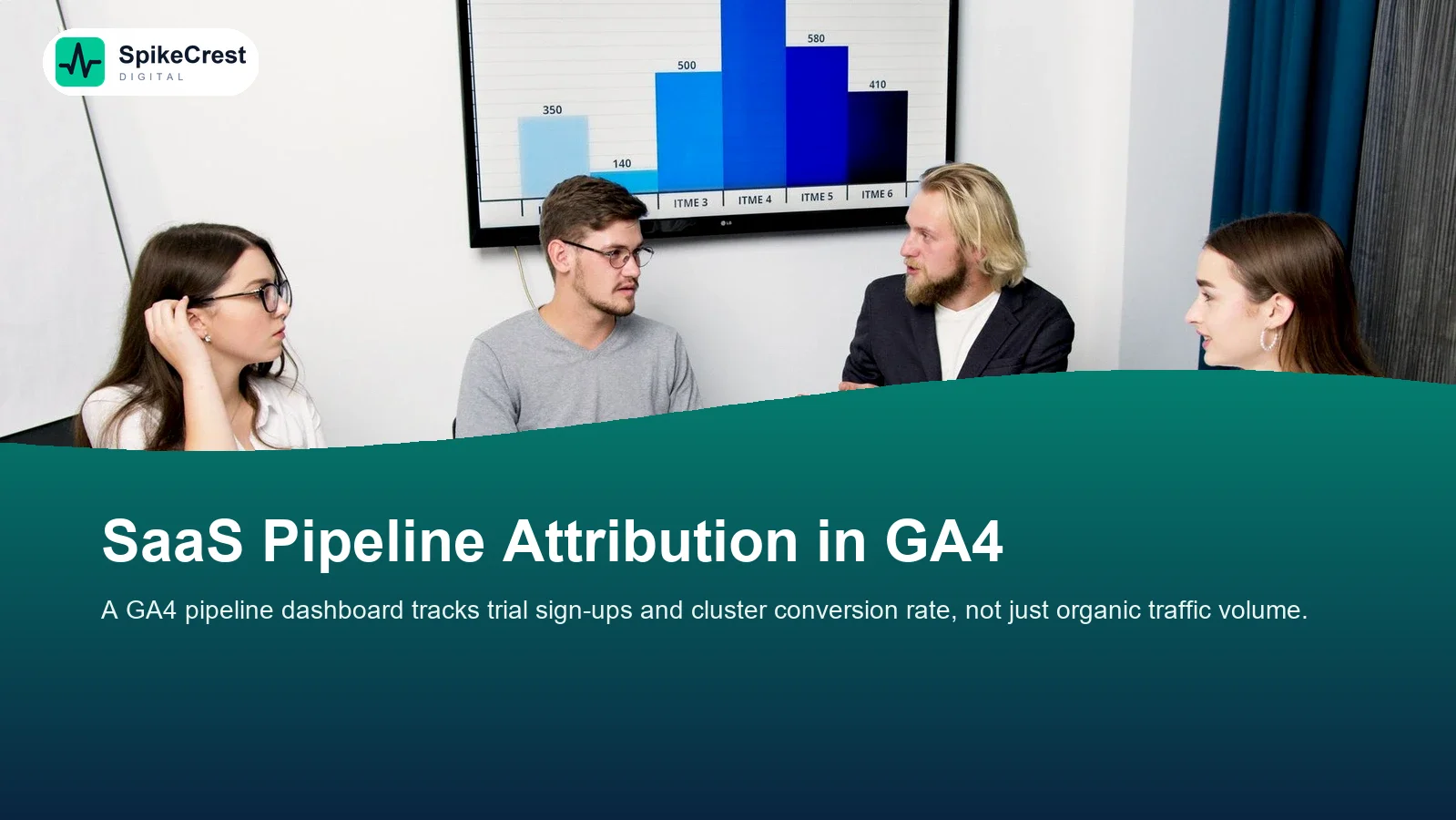
| Metric | What it measures | Tool | Pipeline relevance |
|---|---|---|---|
| Organic trial sign-ups | Users arriving via organic search who start a free trial | GA4 conversion event on trial confirmation URL | Direct pipeline signal — most important SaaS SEO KPI |
| Organic demo bookings | Users arriving via organic search who book a demo call | GA4 + CRM first-touch attribution via UTM | Direct pipeline signal, higher ACV indicator than self-serve trial |
| Cluster conversion rate | % of organic visitors from a specific content cluster who start a trial | GA4 content group segmentation + conversion event | Shows which clusters generate pipeline vs. traffic only |
| Organic MQL rate | % of organic trial starts that meet MQL qualification criteria | CRM with organic first-touch UTM | Revenue attribution — bridges SEO to sales team reporting |
| AI mention frequency | How often the brand appears in ChatGPT and Perplexity answers for 10 target buyer queries | Manual monthly prompt logging in a shared doc | AEO pipeline proxy — leading indicator of AI-driven referral traffic growth |
Rankings and click volume appear in the reporting appendix — the primary monthly KPIs are organic trial sign-ups, cluster conversion rate, and AI mention frequency.
Which Pipeline Metrics Should SaaS Teams Track Instead of Rankings?
The 5 pipeline metrics SaaS teams should track instead of keyword rankings are organic trial starts, cluster conversion rate, organic MQL rate, demo booking rate, and AI mention frequency — each is a revenue signal, not a vanity signal.
- Organic trial starts — GA4 conversion event fired on the trial confirmation page; filter by session source = organic search; benchmark: a healthy SaaS SEO programme generates 15–40 organic trial starts per month within 6 months of launch
- Cluster conversion rate — segment organic traffic by content group in GA4 (set up via a GTM custom dimension); calculate trial starts from cluster divided by sessions from cluster; BOFU clusters should convert at 1–3%, TOFU at 0.05–0.2%
- Organic MQL rate — pass GA4 client IDs into CRM on form submit via GTM Data Layer; calculate MQLs with organic first-touch divided by total organic trial starts; benchmark: 15–25% is a healthy outcome for a SaaS company with a well-qualified ICP
- Demo booking rate — same GA4 + CRM attribution flow; track the subset of organic visitors who book a product demo, a higher ACV indicator than self-serve trial starts
- AI mention frequency — log monthly by sending 10 target buyer queries to ChatGPT and Perplexity and recording how often the brand name appears; track month-over-month direction, not absolute frequency
Reporting these 5 metrics monthly changes the stakeholder conversation from position-tracking commentary to revenue attribution — the difference between an SEO programme that gets cut at the next budget review and one that gets doubled.
What Does a SaaS SEO Dashboard Look Like in GA4?
A SaaS SEO dashboard in GA4 uses content groups, conversion events, and funnel exploration reports to show the full path from organic keyword entry to trial confirmation — not just sessions and bounce rate. Set it up in three parts: create content groups by cluster using a GTM custom dimension that classifies every URL on page load (e.g. “TOFU-Churn-Prevention”, “MOFU-CRM-Comparison”, “BOFU-Competitor-Alternative”); define conversion events — trial_started, demo_booked, resource_downloaded — each confirmed via DebugView before reporting; and build a funnel exploration report tracking organic session entry through product page view, pricing page view, and trial confirmation.
Three weekly reports replace a 50-row keyword position-tracking spreadsheet with a revenue-facing view of the SEO programme: the organic conversion report by content group, the organic landing page report filtered to conversion events, and an AI mention log maintained manually as a shared spreadsheet, updated monthly with ChatGPT and Perplexity prompt outputs.
How Does AI Answer Engine Optimization Fit Into a SaaS SEO Strategy?
AI answer engine optimization fits into a SaaS SEO strategy as the entity authority layer — the set of actions that determine whether a SaaS brand appears in AI-generated answers when a buyer asks ChatGPT or Perplexity which tool to use for their use case. Standard SEO targets the blue-link SERP; AEO targets the synthesised answer that appears before the blue links in Google AI Overviews, or replaces the SERP entirely when buyers use ChatGPT or Perplexity as research tools. For SaaS AI companies, AEO is not optional: a buyer asking “what is the best AI CRM for B2B SaaS” in ChatGPT will see a recommended tool list, and if the brand is absent from that list, the website visit never happens.
Every pillar page in the cluster should include SoftwareApplication or Product schema (category classification), explicit category statements in the first paragraph (entity clarity), and a FAQ section with FAQPage schema (AI model Q&A extraction). SpikeCrest Digital’s AI answer engine optimization for SaaS service builds this exact managed AI visibility strategy as part of a growth retainer.
What Is AEO and Why Does It Matter for SaaS Brands in AI Search?
AEO — Answer Engine Optimization — is the practice of structuring SaaS content and entity signals so AI models extract and recommend the brand when a buyer uses ChatGPT, Perplexity, or Google AI Overviews to research a software category. AEO matters more for SaaS than for most other categories because SaaS buyers are early AI adopters by definition — they research in AI tools before they research in Google. If a SaaS brand has no entity footprint in AI-indexed sources, it is invisible to its highest-intent buyers at the most critical decision stage.
The 3 AEO fundamentals for SaaS are entity clarity (the brand’s category, primary use case, and target customer stated explicitly in structured data and in the first paragraph of every pillar page), FAQ coverage (AI models extract Q&A pairs from FAQPage schema, and every pillar page needs a FAQ section with schema markup), and an authoritative citation network (AI models weight brands mentioned in multiple high-authority external sources more heavily than brands with strong Google rankings but a weak external mention profile).
How Do You Optimize SaaS Content for ChatGPT and Perplexity?
To optimize SaaS content for ChatGPT and Perplexity, you structure every pillar page with direct answer openings, FAQPage schema, and explicit category statements — the three signals AI models prioritise when extracting brand recommendations for software queries. The 5 steps to optimise a SaaS pillar page for AI model extraction are:
- Open the first paragraph with an explicit category statement in this format: “[Brand] is a [applicationCategory] tool that [primary job-to-be-done] for [target audience]” — the sentence AI models most reliably extract as the brand’s description
- Add FAQPage schema to every pillar page — target the exact questions buyers ask in ChatGPT as FAQ H3 headings, with concise 40–60 word answers that reference the brand by name in the third person
- Implement SoftwareApplication or Product schema on the homepage and product pages — include applicationCategory, targetAudience, and offers (pricing) properties
- Earn 5 or more external mentions in sources that AI models index — a G2 profile, a Capterra listing, one tech-media editorial mention, and 2 integration partner pages are a realistic minimum for a new SaaS brand within the first 6 months
- Build brand search volume through awareness campaigns (LinkedIn organic, YouTube, email newsletter) that drive direct searches for the brand name — a signal AI models use to weight recommendation confidence
A SaaS brand that completes all 5 steps within 90 days of launch is significantly more likely to appear in AI-generated tool recommendations than one that focuses on Google rankings alone.
What Structured Data Signals Do AI Models Use to Surface SaaS Brands?
AI models use 3 classes of structured data to surface SaaS brands in generated answers — category schema, review aggregator data, and FAQ schema — each contributing to a different dimension of the model’s entity confidence for a given software category. AI models are not parsing HTML for keywords the way Google’s crawler does — they are resolving entity relationships and category membership from structured signals.

The 3 structured data types that most directly improve a SaaS brand’s AI visibility are:
- SoftwareApplication schema: declares applicationCategory (e.g. “CRM Software”), operatingSystem, targetAudience, and offers (pricing tier data) — AI models use applicationCategory and targetAudience to match the brand to buyer queries
- FAQPage schema: provides AI models with pre-formatted Q&A pairs extracted directly into generated answers — the most reliable schema type for appearing in Google AI Overviews and Perplexity answer boxes
- Organization schema with sameAs: establishes entity identity — name, url, and sameAs links to Wikidata, LinkedIn, Crunchbase, and AngelList — the primary signal AI models use to disambiguate a brand name that is generic or shared
All 3 schema types must be implemented as JSON-LD in the page head — not as microdata attributes scattered through the HTML — because JSON-LD is the format AI crawlers and Google’s structured data parser process most reliably and completely.
Frequently Asked Questions About SaaS AI SEO Strategy
How Long Does It Take for a SaaS Company to See SEO Results?
SaaS companies see measurable pipeline impact from SEO in 4–6 months when they prioritise BOFU competitor-alternative pages in month 1 — not after the 12-month TOFU authority-building runway most generalist agencies recommend. Months 1–2: technical SEO audit completed, site architecture corrected, first 5 BOFU competitor-alternative pages published. Months 3–4: BOFU pages begin ranking for low-competition alternative terms, first organic trial starts appear in GA4, MOFU pillar pages published. Months 5–6: MOFU cluster content indexed and ranking for use-case terms, organic trial attribution visible in CRM, AI mention frequency measurable. Months 7–12: TOFU cluster content begins ranking, brand search volume growing, AI brand recommendation frequency increasing.
The 12-month timeline myth persists because timelines are usually quoted by time elapsed rather than by keyword competition. A SaaS brand that launches 5 well-structured BOFU pages in week 1 can see organic trial starts within 60 days for competitor-alternative terms where existing competitors rank with thin, no-schema content.
Should a SaaS Company Do SEO In-House or Hire a Specialist Agency?
The key difference between in-house SaaS SEO and a specialist agency is execution speed — an agency with SaaS-specific experience compresses a 9-month internal ramp-up into 8–10 weeks because the keyword frameworks, cluster templates, and link-building relationships are already built.
| Factor | In-house SaaS SEO | Specialist SaaS SEO Agency |
|---|---|---|
| Cost | Full-time hire plus tools: KSh 150,000–300,000/month | Specialist retainer with tools included: KSh 75,000–250,000/month |
| Speed to first results | 6–9 months (hiring, onboarding, ramp-up, then execution) | 4–6 months (execution begins in week 1 with pre-built frameworks) |
| SaaS pipeline attribution | Requires upskilling in GA4 + CRM integration or a second data hire | Specialist agencies deliver a working GA4 pipeline dashboard in month 1 as standard |
| AEO and AI visibility | Requires a separate upskilling investment or additional contractor | Integrated into specialist SaaS SEO retainers alongside standard SEO deliverables |
| Strategy ownership | Full internal IP — no dependency risk | Strategy lives with the agency; requires clear handover clauses for IP and access |
For a SaaS company at seed to Series A with under 10 marketing headcount, a specialist SaaS SEO agency Nairobi typically produces a faster pipeline ROI on the first KSh of spend than building an in-house function from scratch.
What Is the Difference Between SaaS SEO and Product-Led Growth?
The key difference between SaaS SEO and product-led growth (PLG) is traffic acquisition source — SaaS SEO drives organic search visitors to the product, while PLG drives growth through the product’s own in-app viral loops and referral mechanics. The two are complementary: a SaaS company with PLG mechanics still needs organic search to acquire the first users who activate those loops. SEO fills the top of the PLG funnel with problem-aware buyers who discover the product through search before the viral coefficient can operate.
The integration failure that kills this handoff is a weak trial sign-up page: a blog article that drives 1,000 organic visitors but converts at 0.1% due to a slow, confusing, or low-social-proof trial landing page is a PLG failure that looks like an SEO failure in the reporting. The SEO team is responsible for traffic quality; the product team is responsible for trial page conversion — distinct accountability zones.
How Much Does a SaaS AI SEO Strategy Cost in Nairobi?
A SaaS AI SEO strategy in Nairobi costs between KSh 75,000 and KSh 250,000 per month — the range determined by how many services are included: technical SEO only, full content cluster production, link building, and AEO optimization each add scope and investment. Foundation SEO (KSh 75,000/month) covers a technical audit and implementation, keyword research, on-page optimisation for up to 4 pages per month, and monthly GA4 reporting. Accelerate SEO (KSh 150,000/month) adds full content cluster production (8–10 articles per month), link building outreach (3–5 links per month), and GA4 pipeline dashboard setup. Market Leader SEO (KSh 250,000+/month) adds AEO/GEO optimisation, AI mention monitoring, competitor-alternative page production, and monthly strategy sessions.
SaaS AI SEO costs more than standard local SEO because buyer-journey keyword mapping adds 10–15 hours to the discovery phase that a generalist agency skips, content production requires technical accuracy reviews that generalist writers cannot provide without domain expertise, and AEO/GEO tracking adds a monthly manual prompt-testing protocol with a measurable time cost per cycle. See the full breakdown on the SaaS SEO retainer packages page.
Can a New SaaS Tool Compete Against Established Brands in Organic Search?
Yes, a new SaaS tool can rank and generate trial sign-ups against established brands within 4–6 months by targeting BOFU competitor-alternative keywords where content quality and intent match outweigh domain authority. Established brands rarely build high-quality pages for “[Competitor] alternative” or “[Competitor] vs [New Brand]” queries because doing so legitimises the comparison. A new SaaS brand that publishes a detailed, honest, well-structured alternative page for every major competitor — with a feature-by-feature table, real G2 ratings, and a schema-marked FAQ section — can rank in positions 1–3 for those BOFU terms within 60–90 days, even at low domain authority.
New SaaS brands cannot compete on high-volume TOFU terms against established category leaders in year 1. The correct strategic decision is to skip those terms in the first 12 months, capture BOFU and niche MOFU pipeline now to fund operations and link-building investment, and use the organic revenue from early trial conversions to build the authority required for TOFU competition in year 2 and beyond.