
The 80/20 rule in SEO means that 20% of your optimization effort drives 80% of your organic traffic, leads, and revenue.
The 80/20 rule in SEO means that 20% of your optimization effort drives 80% of your organic traffic, leads, and revenue — yet most businesses in Nairobi spread their SEO budget across dozens of tactics that deliver marginal returns. Your vital 20% is a specific set: a handful of high-intent keywords, a small group of top-performing pages, core indexability fixes, and a few high-authority backlinks that Google rewards disproportionately. Identifying your vital 20% starts in GA4 and Google Search Console, where traffic, engagement, and goal-completion data reveal exactly which pages and queries are already doing the heavy lifting.
What Does the 80/20 Rule Actually Mean in SEO?
The 80/20 rule in SEO is a disproportionate distribution of results where roughly 20% of your optimization inputs — keywords, pages, and links — generates approximately 80% of your measurable organic outcomes. This pattern, the Pareto Principle, is directly measurable in GA4 and Search Console: a typical site before SEO intervention shows 3-5 pages driving 60-80% of its organic leads.
The most common misconception is that the 80/20 rule means ignoring 80% of SEO activity. It does not — it means sequencing investment so the highest-leverage tasks come first. A site that spends its first six months resolving indexability issues and optimizing commercial pages will outperform a site that spreads the same budget across 15 parallel initiatives.
Where Did the Pareto Principle Come From and Why Does It Apply to SEO?
The Pareto Principle comes from Vilfredo Pareto’s 1906 observation that 80% of Italy’s land was owned by 20% of the population. Management consultant Joseph Juran formalized the concept as the “vital few and trivial many” in the late 1940s, applying it to quality control and business resource allocation.
It applies to SEO because Google’s algorithms reward relevance signals non-linearly. A page that earns one high-authority, topically relevant backlink may see a disproportionate ranking lift compared to ten low-authority links combined. Resolving one critical indexability error can unlock ranking potential for 50 pages simultaneously, while fixing 50 minor on-page errors may shift rankings by fractions of a position.
How Does the 80/20 Distribution Show Up in Real Organic Traffic Data?
The 80/20 distribution shows up when you sort Google Search Console pages by total clicks and find that the top 10-20% of your indexed URLs account for the large majority of impressions and goal completions. Three common patterns appear consistently in GA4 and Search Console data:
- A handful of service pages generate the bulk of enquiries while hundreds of informational pages generate near-zero conversions
- A small cluster of high-intent keywords delivers the majority of converting sessions while long-tail queries account for most of the keyword footprint by volume
- A few high-domain-rating referring domains contribute the majority of the site’s backlink authority score while low-DR links contribute negligible signal
Identifying these three patterns in the first 30 days of a campaign tells you exactly where to concentrate effort before building anything new.
Which SEO Activities Drive 80% of Organic Traffic Results?
The SEO activities that drive 80% of organic traffic results are technical indexability fixes, high-intent keyword targeting on commercial pages, and earned topical authority — not broad keyword volume chasing, link quantity accumulation, or tactical scatter across unrelated channels.
The five SEO activities that consistently generate disproportionate organic traffic returns are:
- Technical crawlability and indexability audit — removing the barriers that prevent Google from discovering and indexing key pages
- High-intent keyword targeting on commercial pages — aligning service pages with the exact transactional queries buyers use when ready to engage
- Topical authority content — cluster articles that reinforce core service pages in Google’s understanding of the site
- Internal linking from high-traffic pages to commercial pages — passing earned authority to the pages that generate revenue
- High-authority link acquisition — a small number of links from trusted, topically relevant domains rather than link volume from low-quality sources
Each of these five activities compounds over time — the earlier they run in the campaign, the larger the organic returns in months 6-12.
Why Do High-Intent Keywords Generate More Conversions Than Head Terms?
High-intent keywords generate more conversions than head terms because searchers using specific, buyer-stage queries have already completed their research. Head terms are broad (“marketing agency”); high-intent modifiers are specific and transactional (“Google Ads agency Nairobi pricing”). Buyer-stage queries convert at 3-8x the rate of informational queries on the same topic because the searcher’s decision-making work is done before they click.
How Does a Small Number of Pages Deliver Most of a Site’s Organic Sessions?
A small number of pages delivers most of a site’s organic sessions because Google concentrates ranking authority on pages that most completely satisfy a query’s search intent.
| Page type | Typical organic traffic share | Primary reason it outperforms |
|---|---|---|
| Service or commercial page | 40-60% | Directly satisfies transactional queries with a specific offer |
| High-authority pillar article | 20-30% | Earns backlinks that flow authority to linked commercial pages |
| Location-specific landing page | 10-20% | Satisfies local intent with geographic modifiers |
| Supporting cluster article | 5-15% | Builds topical authority; converts directly at a very low rate |
| Low-relevance blog post | 1-5% | No buyer-stage alignment — drives traffic but not enquiries |
These distributions shift as the site earns topical authority — in months 9-12, cluster articles that have earned backlinks of their own often enter the top 20% of traffic drivers.
How Does the Pareto Principle Apply to Technical SEO Fixes?
The Pareto Principle applies to technical SEO by revealing that indexability issues — crawl errors, canonical misconfigurations, and mobile usability failures — block ranking for every affected page simultaneously, making them worth fixing before any content or link building investment. Mobile usability is especially critical in the Kenyan market, where the majority of searches happen on mobile, meaning a CLS or tap-target failure affects a disproportionate share of organic visitors.
The technical SEO fixes that generate the largest ranking impact — in Pareto priority order — are:
- Crawlability and indexability — robots.txt errors, noindex tags on commercial pages, and broken internal links that eliminate ranking potential entirely
- Mobile usability — CLS threshold failures, undersized tap targets, and viewport errors that reduce mobile ranking eligibility site-wide
- Core Web Vitals — LCP, INP, and CLS scores that affect both page experience signals and real engagement metrics
- Structured data — missing Article, LocalBusiness, and FAQPage schema that removes eligible pages from rich result features
- Internal linking structure — orphaned pages, equity-leaking redirect chains, and missing links from informational to commercial pages
After these five categories are resolved, remaining technical issues — image compression, minor TTFB variations — deliver diminishing returns relative to content and link building investment.
Which Technical Issues Block Indexability More Than Any Other Factor?
Crawlability failures block indexability more than any other factor because Google cannot rank a page it cannot discover, process, and store in its index. Indexability has three layers: crawlability (can Google reach the URL?), indexability (is it allowed into the index?), and rendering (can Google process the content?). Diagnose these using Search Console’s Coverage report — specifically the Excluded tab — and confirm indexation of priority pages with the URL Inspection tool.
Why Do Core Web Vitals Rank Higher Priority Than Minor On-Page Errors?
Core Web Vitals rank higher priority than minor on-page errors because Google confirmed them as ranking signals in 2021 and because they measure whether a page delivers a usable experience site-wide, not just on one page. The three Core Web Vitals are LCP (under 2.5 seconds), INP (under 200 milliseconds), and CLS (under 0.1) — thresholds documented on Google’s web.dev site. Minor issues like duplicate meta descriptions affect individual page relevance signals; Core Web Vitals affect ranking eligibility across the entire domain.
What Type of Content Generates 80% of Organic Leads for a Business?
Commercial-intent content — service pages, landing pages, and comparison pages targeting buyer-stage search queries — generates 80% of organic leads because it aligns with the exact queries people use when ready to engage a business. For a Nairobi business, the content plan should prioritize pages targeting “SEO agency Nairobi pricing” before publishing informational how-to articles.
| Content type | Typical organic conversion rate | Pareto priority |
|---|---|---|
| Service or commercial page | 3-8% CVR | Priority 1 — publish first |
| Comparison or alternative page | 2-5% CVR | Priority 2 |
| Pillar article (topical authority hub) | 0.5-2% CVR | Priority 3 |
| Supporting cluster article | 0.1-0.5% CVR | Priority 4 |
| Informational FAQ or glossary page | Under 0.1% CVR | Priority 5 |
Commercial pages generate the majority of organic leads, while informational content supports their authority and topical completeness over time.
How Do You Identify the Content Topics That Build Topical Authority Fastest?
You identify the content topics that build topical authority fastest by mapping your target keyword clusters to the entities and attributes Google already associates with your niche — then publishing in the sequence that fills the most significant coverage gaps first. Three methods: audit your existing content map against a topical authority framework to find sub-topics with no dedicated page; review Google’s People Also Ask and Related Searches for recurring reader questions with no existing answer on your site; and analyse competitor topical maps in Ahrefs or Semrush to find cluster articles competitors rank for that your site does not have.
Should You Focus on Commercial-Intent or Informational Content First?
Yes, commercial-intent content should be published first because it generates enquiries and revenue while the site’s topical authority is still building. Commercial pages indexed in months 1-2 begin accruing ranking signals while informational content develops for months 3-6. One exception: an informational topic with high link-earning potential — a data-led study, a comprehensive how-to guide journalists will cite — should launch alongside commercial pages so authority flows directly into them via internal links.
Why Do a Few High-Authority Backlinks Outperform Hundreds of Low-Quality Links?
A few high-authority backlinks outperform hundreds of low-quality links because Google’s PageRank algorithm weights each link by the referring domain’s trustworthiness and topical relevance, not by raw link count. The top 10-20% of a backlink profile by domain authority typically accounts for 80% of the site’s authority score in tools like Ahrefs or Semrush.
The three qualities that determine whether a backlink belongs in your vital 20% are:
- Domain Rating or Domain Authority — links from DR 40+ domains generate meaningful impact; DR 5-15 links contribute marginal signal regardless of quantity
- Topical relevance — an off-topic link carries less ranking signal even at high DR
- Link placement — in-content editorial links generate stronger signals than footer or sidebar links, which Google treats as navigational
Auditing your existing backlink profile against these three criteria immediately identifies which links belong in your vital 20%.
How Do You Find Your Vital 20% in SEO Using GA4 and Google Search Console?
You find your vital 20% by filtering GA4 and Google Search Console for the pages and queries generating the highest organic sessions, engagement rates, and goal completions — then protecting and expanding what already works. This two-tool audit takes 30-45 minutes.
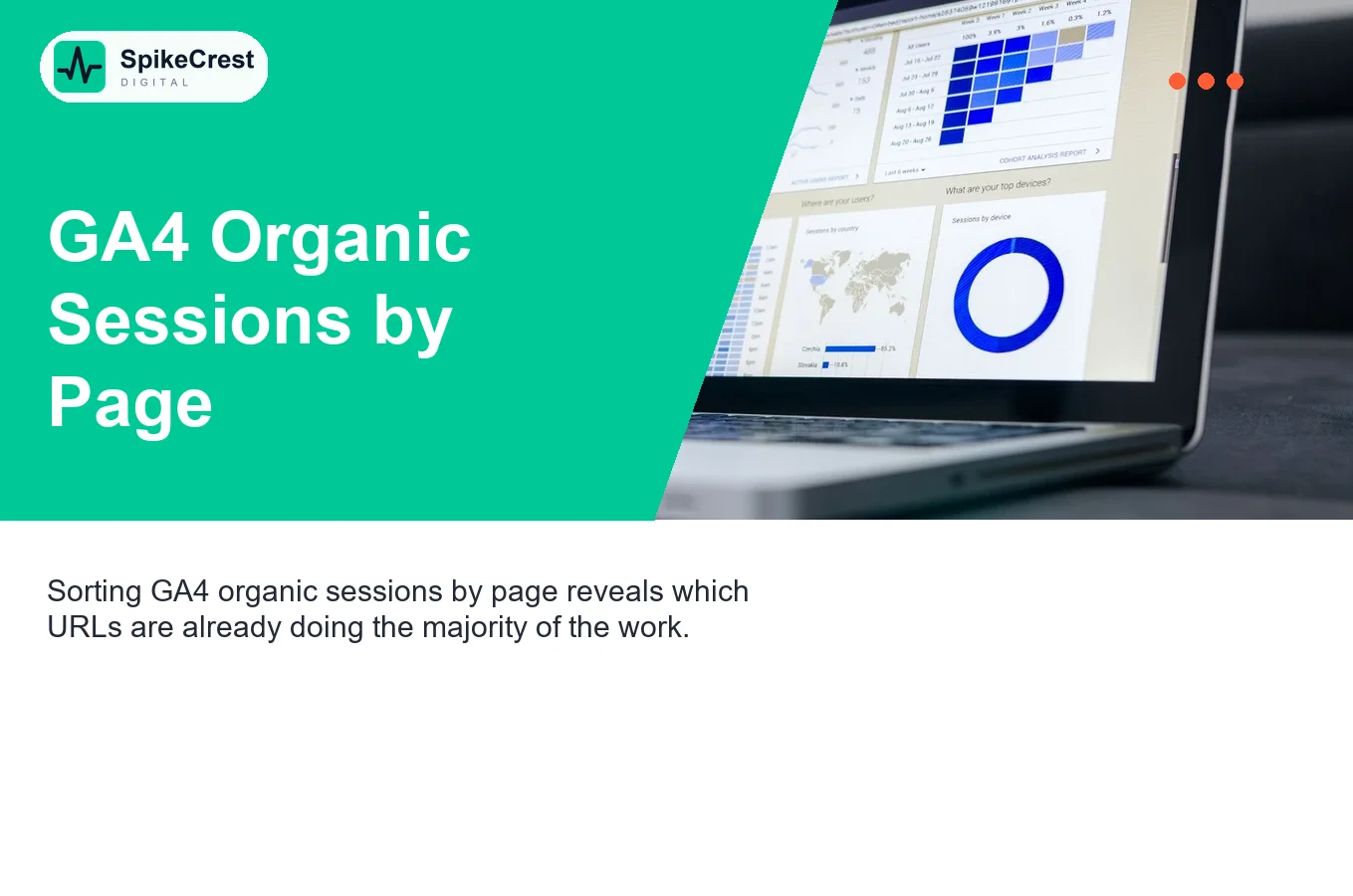
The four-step process for identifying your SEO vital 20% is:
- Open GA4 Reports → Acquisition → Traffic Acquisition, filter by Organic Search, and sort by Sessions descending to identify the top 10-20% of URLs driving traffic
- Cross-reference those URLs in Search Console under Performance → Pages — note average position, impressions, and CTR
- Filter GA4 for Key Events attributed to Organic Search — form submissions, WhatsApp clicks, calls — to identify which high-traffic pages also convert
- Flag pages in the top 20% by both traffic and conversions as your vital few — these get the next internal linking update, schema addition, and content refresh before any new pages are built
Pages in the top traffic tier but outside the conversion tier reveal a content-to-conversion gap — typically a search-intent mismatch a focused CRO audit resolves.
What GA4 Metrics Reveal Which Pages Are Generating 80% of Your Organic Revenue?
The GA4 metrics that reveal which pages generate 80% of organic revenue are Sessions from Organic Search, Engagement Rate, and Key Events. Set up an Organic Search comparison segment under Explore first, since GA4’s default reports blend direct, paid, and referral traffic.
| GA4 metric | What it reveals | Pareto application |
|---|---|---|
| Sessions from Organic Search | Raw organic traffic volume per page | Identifies the top-traffic 20% |
| Engagement Rate | % of sessions 10+ seconds with interaction | Flags high-traffic pages with an intent mismatch |
| Key Events (form, WhatsApp, call) | Actual conversion actions | Identifies the vital 20% by revenue impact |
| Average Engagement Time per Session | Time spent per organic session | Distinguishes deep pages from bounce-heavy thin ones |
Run this four-metric Pareto audit monthly — your vital 20% shifts as the site earns new rankings.
How Do You Use Google Search Console to Identify High-Impression, Low-Click Keywords?
You use Search Console to identify high-impression, low-click keywords by sorting the Performance report by Impressions descending, then filtering for queries with CTR below 3% — a title tag rewrite here delivers immediate traffic gains without new content investment. The three-step process: export the full 90-day query dataset from Performance → Search Results; sort by impressions and flag queries with 500+ impressions and sub-3% CTR; rewrite the title tag to include the query within the first 40 characters plus a specific outcome signal, then monitor CTR over the next 28 days. This process typically surfaces 5-15 quick-win optimizations within the existing page inventory.
Where Should Your SEO Investment Go First to Generate Maximum Organic Return?
Your SEO investment should go first to technical indexability fixes and commercial page optimization — the tasks that unblock Google’s ability to rank your existing pages before any new content or link building budget is committed. Fix indexability first, optimize commercial pages second, earn a small number of authoritative backlinks third, then build supporting topical content to reinforce authority.
Knowing which tasks belong in the vital 20% is necessary but not sufficient — without a structured prioritization system, most teams revert to comfortable tasks rather than high-impact ones. See how to prioritize your SEO tasks for the full framework.
How Do You Build an SEO Prioritization Framework When Budget Is Limited?
You build an SEO prioritization framework by scoring every identified task against its expected impact, implementation confidence, and effort cost — then executing the highest-scoring tasks first. The most widely used framework is ICE (Impact, Confidence, Ease), though PIE and PXL are also used for sprint planning.
Four principles for a budget-constrained prioritization framework:
- Impact ceiling — score each task 1-10 on expected traffic or conversion lift; tasks scoring 8-10 enter the next sprint first
- Confidence multiplier — discount the impact score by delivery certainty; a documented indexability fix carries 90% confidence, an untested topic 40-60%
- Effort ceiling — score 1-10 on implementation hours; low-effort, high-impact tasks (title tag rewrites, schema additions) are the purest expression of the 80/20 rule
- Review cadence — review the priority list every 30 days as ranking data arrives
This scoring process takes 30-60 minutes per sprint review and ensures available hours go to the 20% of tasks that generate 80% of ranking improvements.
What Is the ICE Scoring Framework and How Does It Apply to SEO Task Ranking?
ICE scoring is a task prioritization method that rates every SEO task on Impact, Confidence, and Ease — tasks are ranked by total score to sequence the sprint backlog. ICE was developed by Sean Ellis in growth marketing.

| SEO task | Impact | Confidence | Ease | ICE Total |
|---|---|---|---|---|
| Fix noindex tag on primary service page | 9 | 10 | 9 | 28 |
| Rewrite title tags for top 10 high-impression low-CTR queries | 7 | 8 | 9 | 24 |
| Add FAQPage schema to top 5 indexed pages | 6 | 8 | 8 | 22 |
| Publish pillar article targeting a 1,000+ monthly search keyword | 7 | 6 | 5 | 18 |
| Build 3 high-DR backlinks via digital PR outreach | 9 | 5 | 3 | 17 |
The task with the highest ICE score enters the next sprint first — this keeps Pareto prioritization systematic rather than instinct-driven.
How Do You Decide Whether to Fix Technical Issues or Publish New Content First?
You fix technical issues before publishing new content because content on a site with indexability failures will not rank regardless of its quality. If Search Console’s Coverage report shows Excluded pages for controllable reasons — noindex tags, soft 404s, crawl anomalies — fix those first. The one exception: if issues are minor and main commercial pages already have clean indexability, run content and minor technical cleanup in parallel.
Frequently Asked Questions About the 80/20 Rule in SEO
Does Pareto Thinking Apply Differently to Local SEO Than National Campaigns?
Yes, Pareto thinking applies differently to local SEO because the vital 20% in local search is dominated by Google Business Profile optimization and NAP citation consistency rather than backlink volume or content breadth. Local SEO’s vital 20% includes a fully optimized GBP — accurate categories, weekly posts, a review velocity of 4-8 new reviews per month — alongside NAP consistency and a location-specific landing page. National SEO’s vital 20% shifts toward topical authority content and high-DR backlinks, since there is no Map Pack intent to satisfy.
What Happens to Your Rankings When You Spread SEO Effort Across Too Many Tactics?
Rankings stagnate when SEO effort is spread across too many tactics because no single ranking signal reaches the threshold Google requires to trigger a position improvement. A page 60% optimized for a target keyword rarely ranks on page 1; a page 90-95% optimized often does. The Pareto correction is to identify the 2-3 tasks that push your vital pages from 70% to 90%+ and finish them before starting anything else.
How Often Should You Review Which 20% of Your SEO Is Driving Results?
The best time to review which 20% of your SEO is driving results is monthly for traffic and conversion data and quarterly for keyword ranking position changes, because organic search signals take 30-90 days to reflect the optimizations made to a page. If a page that drove 30% of organic leads in Q1 drops to 5% in Q3, it needs a content refresh, an internal link audit, or a new backlink campaign — the vital few require proactive quarterly maintenance, not a set-and-forget approach.
Can a Small Business Apply 80/20 Thinking to SEO Without Hiring a Specialist?
Yes, a small business can apply 80/20 thinking to SEO without hiring a specialist by focusing on three actions that require no prior SEO knowledge: fixing Google Search Console coverage errors, updating title tags on the five highest-traffic pages, and completing a Google Business Profile. An SEO agency adds disproportionate value where budget allows — link acquisition, topical authority strategy, and full technical crawl audits require specialist expertise. SpikeCrest Digital’s Foundation SEO package at KSh 75,000 per month is a starting point for businesses that want a structured Pareto-aligned campaign without building in-house SEO capability.