SEO in 2026 works across two parallel tracks: building topical authority and E-E-A-T signals that rank in Google, while optimising for citation in AI answer engines like ChatGPT and Perplexity.
How does SEO work in 2026? SEO in 2026 works across two parallel tracks: building topical authority and E-E-A-T signals that rank in Google, while simultaneously optimising for citation in AI-powered answer engines like ChatGPT and Perplexity. Google’s algorithm evaluates pages against 200+ confirmed signals — but the three pillars that determine rankings remain technical foundation, content relevance, and link authority. For Nairobi businesses, the practical implication is that ranking in 2026 requires more than keywords: it requires structured content that both search engines and AI retrieval systems can evaluate, verify, and cite.
Is SEO Still Working in 2026?
SEO still works in 2026 — Google processes over 8.5 billion searches per day (some 2026 trackers put daily volume considerably higher), and organic results capture the majority of clicks on commercial and informational queries. The mechanism has evolved but the investment case has not changed: businesses that built strong topical authority in 2023 still rank in 2026.
The specific change is AI Overviews. Google’s AI-generated summaries now appear above organic results on a large and growing share of queries, a pattern tracked by BrightEdge and covered extensively by Search Engine Land. This has reduced clicks on some informational queries, but it has not eliminated the value of organic rankings on commercial and transactional queries, where buying intent is present and users scroll past the AI summary to compare specific providers.
Why Did SEO Not Collapse When Google Launched AI Overviews?
SEO did not collapse after AI Overviews launched because Google’s AI-generated answers source their content from the same organic results that strong SEO builds. Pages cited in AI Overviews are predominantly drawn from top-ranking organic pages — a strong SEO position increases citation probability in the AI summary, not just the ranked list. Semrush’s AI Overviews correlation research has repeatedly shown that pages already ranking in positions 1–5 organically are cited at a far higher rate than lower-ranked pages.
How Much Traffic Do Organic Results Still Receive in 2026?
To quantify organic traffic share in 2026, you need to separate query types — commercial and transactional queries still deliver the majority of their clicks to organic results, while informational queries have seen the largest erosion from AI Overviews and featured snippets. Backlinko’s click-through-rate research puts the average CTR for the first organic position well above every other position on the page for commercial queries. For Kenyan businesses, where Google holds over 95% of search market share, organic search remains the single largest qualified-traffic channel for most industries.
How Does Google’s Algorithm Actually Rank Pages in 2026?
Google’s algorithm ranks pages in 2026 by evaluating over 200 confirmed and inferred signals — but the dominant weight goes to topical authority, E-E-A-T compliance, page experience, and entity-based relevance. The signal categories that have strengthened since 2023 are consistent across independent industry research and the 2024 Google Search API leak.
The 5 signal categories Google weights most heavily in 2026 are:
- Topical authority — breadth and depth of coverage on a single subject area, evaluated at site level across the full content cluster rather than on an isolated page
- E-E-A-T signals — evidence of experience, expertise, authoritativeness, and trustworthiness on the page and at domain level, including named author credentials and cited sources
- Page experience — Core Web Vitals scores (LCP under 2.5s, INP under 200ms, CLS under 0.1), mobile usability, and HTTPS
- Entity and semantic relevance — how well the page’s content graph matches knowledge-graph relationships for the query entity
- Link authority — quality and contextual relevance of inbound links from authoritative domains in the same topical space
Nairobi businesses competing in high-intent niches — legal, medical, financial services — need all five signal categories working together. A technically sound site with thin or unattributed content will not sustain rankings against a competitor who has built genuine topical authority over 12+ months.

What Changed After the Google March 2024 Core Update?
The March 2024 Core Update targeted low-quality, unoriginal content in Google’s top-10 ranking positions — one of the largest single-update content devaluations in Google’s confirmed history. Google’s own announcement stated the update aimed to reduce such content by 40%, and the company later said it exceeded that target, cutting low-quality, unoriginal content by 45%. Google specifically targeted AI-generated content without original perspective, content scaled for keyword volume without genuine topical depth, and thin pages across unrelated topics that dilute overall site authority. The actionable implication: publishing fewer, semantically complete articles on a single topic cluster outperforms publishing high-volume keyword-matched content across unrelated subjects.
Which Ranking Signals Carry the Most Weight in the Current Algorithm?
The ranking signals that carry the most weight in 2026 are content depth and E-E-A-T, followed by topical authority breadth across the full content cluster and inbound link quality from contextually relevant domains. Keyword density as an isolated signal no longer functions as a meaningful lever — Google’s algorithm processes semantic relationships between entities rather than counting how many times a phrase appears. The April 2024 Google Search API leak confirmed siteAuthority as an operational ranking factor alongside NavBoost user-engagement signals, including dwell time and return-to-SERP rate.
What Are the Three Pillars of SEO That Still Drive Rankings?
The 3 pillars of SEO that drive rankings in 2026 are technical foundation, content and relevance, and authority and trust — the same structural categories that have underpinned Google’s algorithm since its inception, now measured with far greater precision against E-E-A-T and entity-graph signals. Individual signals shift with every core update, but these three pillars are permanent structures: neglecting any single pillar creates a ranking ceiling even if the other two are strong.

Each pillar covers a distinct dimension of your website’s search performance:
- Build technical foundation — ensure crawlability, fast page load (LCP under 2.5s on mobile), mobile usability, clean site architecture, no index bloat from orphan or duplicate pages, and correct canonical implementation
- Create content and topical relevance — publish semantically complete articles that cover a topic cluster in full, with named author credentials, cited external sources, and original data or observations not available on competitor pages
- Earn authority and trust — acquire inbound links from contextually relevant, authoritative domains through digital PR, editorial content partnerships, and original research that journalists and industry bodies cite
A Nairobi business that builds all three pillars consistently over 12 months will rank for competitive keywords in almost any local niche — because most competitor websites in Kenya are still structurally deficient in at least two of the three pillars simultaneously.
How Does Technical SEO Determine Whether Google Crawls and Indexes Your Pages?
To ensure Google crawls and indexes your pages, you need a technically clean site architecture — Googlebot must be able to discover, fetch, and render every page without encountering crawl blocks, redirect chains, or server-side rendering failures. The most common issues blocking indexation for Kenyan business websites are misconfigured robots.txt files that accidentally disallow crawlers, slow server response times (many Kenyan shared hosting providers deliver TTFB above 800ms, reducing Googlebot’s crawl willingness on low-authority domains), and noindex meta tags left active from development environments that were never removed before launch. Google Search Console’s Coverage Report — specifically the Page Indexing tab — is the primary diagnostic tool.
How Does Content Depth and E-E-A-T Influence a Page’s Ranking Position?
Content depth and E-E-A-T influence ranking position by signalling to Google that the page was produced by someone with genuine experience and verifiable expertise — not assembled from recycled information already indexed elsewhere. The Experience component, added to E-E-A-T in December 2022, specifically rewards first-hand accounts, original research, and attributed observational data. For a Nairobi business, practical E-E-A-T signals include a named author with a linked bio, Kenya-specific data or examples not found on global competitor pages, and in-house photography rather than generic stock imagery.
How Do Backlinks Build SEO Authority in 2026?
Backlinks build SEO authority in 2026 by transferring topical trust from an established, contextually relevant domain to your pages — quantity matters far less than the topical alignment between the linking page and the page receiving the link. Spammy, paid, or contextually irrelevant links carry zero or negative value; Google’s SpamBrain system detects manipulative link patterns at scale, and penalties can suppress entire domains. Three legitimate methods for Nairobi businesses: digital PR publishing Kenya-specific industry data that journalists cite by URL; editorial listings on authoritative Kenyan portals such as government databases and accredited professional bodies; and content partnerships with non-competing, complementary businesses. Guest posting still works — but only editorial, contextually relevant guest posts on genuine editorial publications, never bulk link schemes.
How Has AI Changed the Way Search Engines Process and Rank Content?
AI has changed how search engines process content by shifting evaluation from keyword frequency to entity relationships, semantic completeness, and the verifiable credibility of the source — a change that makes it impossible to rank solely by repeating a target phrase. Google’s MUM and Gemini-based systems evaluate content at a conceptual level, determining whether a page covers a topic comprehensively rather than whether a phrase appears a set number of times. The 2024 Google Search API leak confirmed that semantic clustering, entity graph matching, and site-wide authority signals are operational ranking inputs.

| Factor | Traditional SEO (pre-2023) | AI-Era SEO (2026) |
|---|---|---|
| Primary relevance signal | Keyword frequency and density | Entity-to-topic graph alignment and semantic completeness |
| Content quality measure | Word count and backlink count | E-E-A-T signals, topical authority breadth, and original data presence |
| Search result format | 10 blue organic links | Blue links + AI Overviews + featured snippets + People Also Ask |
| Optimisation target | Google search algorithm only | Google + AI answer engines (ChatGPT, Perplexity, Google AI Overviews) |
| Content evaluation scope | Individual page-by-page assessment | Site-wide topical authority assessed across the full content cluster |
A single well-optimised page no longer wins against a competitor who has built a comprehensive content network around the same topic cluster.
What Is Generative Engine Optimisation and How Does It Differ From Standard SEO?
Generative Engine Optimisation (GEO) is the practice of structuring content so that AI-powered answer engines cite your pages as sources when generating responses — distinct from standard SEO, which targets a position in Google’s ranked list of blue links. SEO delivers a ranked URL where users click through; GEO delivers a citation in an AI-generated answer that may carry no clickable link at all. Brands that invest only in traditional SEO risk being invisible to users who research purchases through ChatGPT, Perplexity, or Google AI Overviews before ever visiting a comparison page.
Which AI Platforms Prioritise Which Types of Sources for Their Answers?
The 3 major AI answer platforms prioritise different source signals. The source prioritisation profile of each is:
- ChatGPT — favours high-domain-authority sources, Wikipedia and Wikidata entity presence, and Bing-indexed content; prioritises .edu, .gov, and established English-language media citations embedded in its training corpus
- Perplexity — performs live web search and prioritises freshness, structured factual answers placed near the top of the page, and direct question-answer format
- Google AI Overviews — draws primarily from top-ranking Google organic results in the same market and language; the strongest single predictor of citation is organic position 1–5 on the same query in the same geographic market
Kenyan businesses should prioritise Google AI Overviews first, because AI Overviews pull from the Kenyan SERP specifically — existing local SEO authority directly increases citation probability, unlike ChatGPT, which relies heavily on global English-language training data that underrepresents African-market content.
What Type of Content Ranks in Google Search in 2026?
Content that ranks in Google in 2026 demonstrates original expertise, matches the specific search intent of the query, and covers the topic with enough semantic depth that Google’s algorithm can verify topical authority at the site level rather than the page level alone. The March 2024 Core Update specifically removed content that passes the surface-level keyword test but fails the E-E-A-T test. Google’s NavBoost system uses engagement signals including scroll depth and return-to-SERP rate as operational ranking inputs; a page that ranks but immediately loses users back to the SERP drops in position over subsequent crawl cycles.
The 4 content characteristics Google rewards with sustained rankings in 2026 are:
- First-hand experience — written by someone who has directly performed, observed, or measured what the article describes, with specific practitioner details a content generation tool cannot produce from existing indexed text
- Source attribution — every externally verifiable claim includes a named, linkable source such as government data or recognised industry bodies, with no unsupported statistics
- Search intent match — the article’s format, length, and angle match what most searchers on that query actually want, whether informational understanding, navigation, comparison, or a transaction
- Entity completeness — the page names, contextualises, and explains every entity directly relevant to the topic, building a semantic knowledge graph Google’s systems can parse and verify
For a Nairobi business owner evaluating their own content, the clearest test is this: does your article contain at least one observation, data point, or example that a generic AI writing tool could not have generated from existing indexed web content alone?
How Long Does SEO Take to Show Results for a Nairobi Business in 2026?
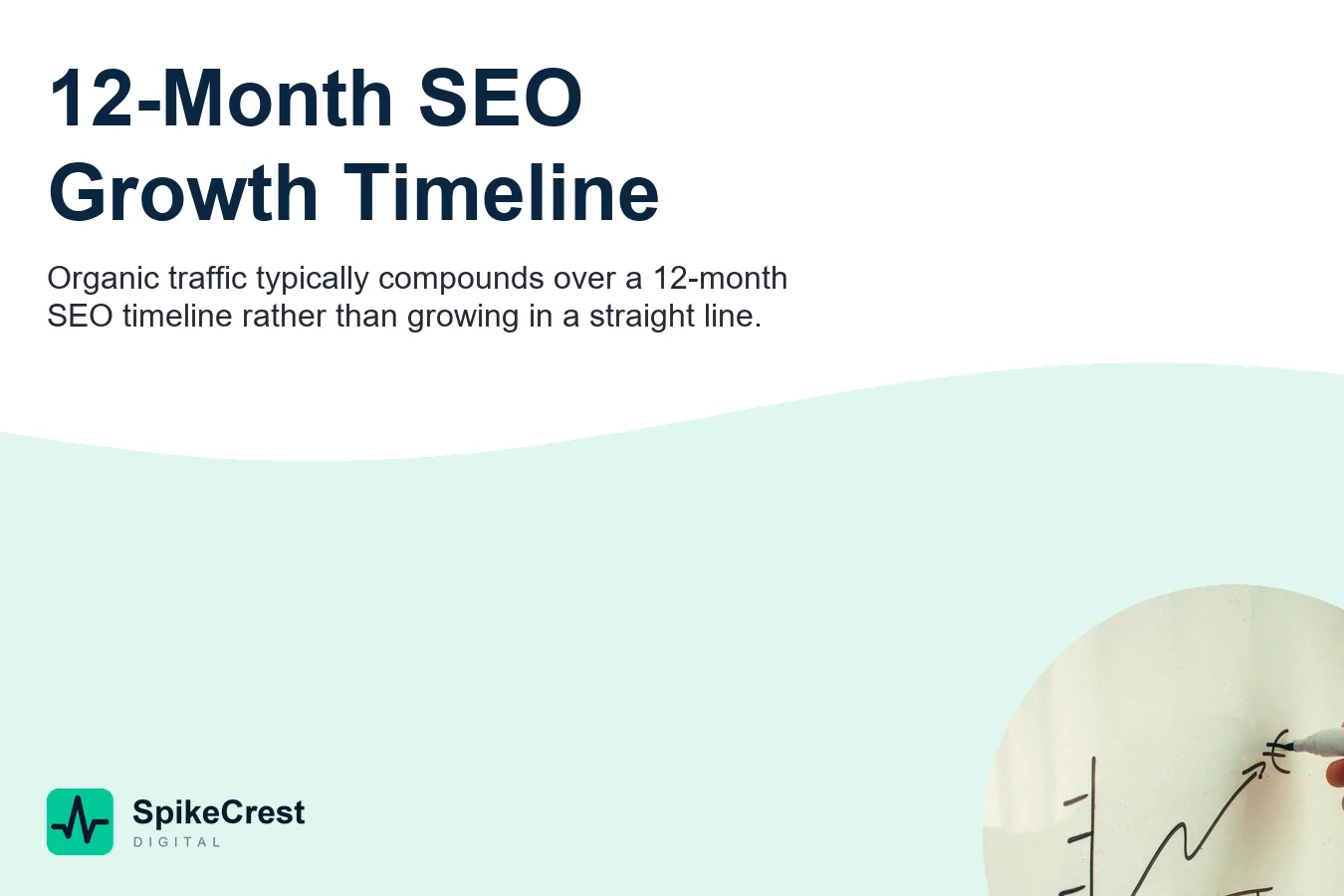
The best time to expect measurable SEO results in 2026 is between months 3 and 6 for initial ranking improvements, and between months 6 and 12 for meaningful organic traffic and lead volume — with the actual timeline depending on domain age, competition level, and content publishing cadence. A website publishing 4 targeted articles per month builds topical authority measurably faster than one publishing 1 article every 6 weeks, regardless of keyword competition level.
| Timeline | What typically happens | What you should do |
|---|---|---|
| Month 1–2 | Technical audit fixes implemented; Google begins re-crawling and indexing revised pages; no visible ranking changes yet | Fix crawl errors, optimise Core Web Vitals, submit updated XML sitemap, resolve indexation gaps |
| Month 3–4 | Long-tail keywords begin entering top 20 positions; first organic impressions appear in Search Console | Publish supporting cluster content; acquire first 5–10 contextually relevant backlinks |
| Month 5–6 | Head terms enter top 10 for lower-competition queries; organic traffic starts measurable growth | Begin CRO work on landing pages receiving organic traffic; track revenue attribution in GA4 |
| Month 7–9 | Topical authority signals accumulate site-wide; medium-competition terms enter top 5 | Expand content cluster into adjacent topical nodes; pursue digital PR for high-authority links |
| Month 10–12 | Competitive head terms enter top 5; organic leads constitute a significant and growing share of total new business | Report KES revenue attribution to confirm ROI; plan second-year expansion |
For brand-new domains in Nairobi competitive niches — digital marketing, legal, medical — expect the conservative end of these ranges; domains with existing crawl history or aged backlink profiles move substantially faster through each phase.
What Is the Difference Between SEO and AEO in 2026?
The key difference between SEO and AEO in 2026 is that SEO targets a ranked position in Google’s link list, while AEO targets a cited mention inside an AI-generated answer. In 2026, the two are complementary: a page that ranks strongly in Google is statistically more likely to be cited in Google AI Overviews. But AEO requires additional structural optimisation beyond standard SEO — entity completeness, direct-answer sentence placement, and structured data types that signal machine-readable factual content to AI retrieval systems.
| Dimension | SEO | AEO |
|---|---|---|
| Primary goal | Rank in organic results | Be cited in AI-generated answers |
| Success metric | Organic position and traffic volume | Citation frequency in ChatGPT, Perplexity, and AI Overviews |
| Content format | Keyword-mapped, intent-aligned articles with supporting topic cluster | Direct factual statements, FAQ-format answers, and HowTo schema |
| Authority signal | Inbound links to specific pages | Domain authority plus brand entity presence in knowledge graph and training corpora |
| Optimisation target | Google search algorithm | ChatGPT, Perplexity, Google AI Overviews simultaneously |
SpikeCrest Digital integrates both disciplines on every client campaign, treating AEO and GEO services as a deliverable alongside traditional Google rankings, not a separate or optional service track.
How Do You Optimise Your Website for Both Google and AI Search in 2026?
To optimise for both Google and AI search engines, you build content that satisfies two retrieval systems simultaneously: the traditional search crawler that evaluates authority and semantic relevance, and the AI extraction system that pulls direct factual answers from structured content. Dual optimisation is one content architecture system designed to satisfy both, not two separate strategies. The strongest heading structure places the direct answer to each heading question in the first sentence of the section — the exact structural pattern AI extraction systems use for factual answer generation.
The 5 steps to dual-optimise your content for Google and AI answer engines are:
- Structure answers directly — place the definitive answer to each heading question in the FIRST sentence after the heading
- Use structured data — implement FAQ, Article, and HowTo JSON-LD schema so both Google and AI crawlers can extract structured facts without parsing flowing prose
- Build entity completeness — name every relevant entity explicitly, with enough contextual description for an AI system to understand the semantic relationship
- Earn citations from authoritative sources — get your brand, data, or proprietary frameworks cited on .gov, .edu, and established media sites
- Publish original data — produce Kenya-specific research, surveys, or case study data that no existing AI training dataset already contains
Applying all five steps consistently across a full content cluster separates sites that appear in AI answers from sites invisible to the growing segment of users who search through AI interfaces instead of traditional Google.
How Do You Get Your Business Cited in ChatGPT and Perplexity?
To get cited in ChatGPT and Perplexity, you need your brand to appear in indexed, authoritative sources those AI systems reference during live search or model training — specifically Wikipedia, established media coverage, and pages that rank in Bing for ChatGPT or Google for Perplexity. Three actionable steps: publish on high-authority third-party editorial platforms where your brand is quoted by name; build a Wikipedia or Wikidata entity page if your company meets notability criteria; and use FAQ-format content with direct factual statements in the first sentence of each section — the passages Perplexity’s live search extracts and surfaces verbatim. AI citation is a longer-term brand-building process spanning 6–18 months, not a one-time technical optimisation.
What Structured Data Signals Do AI Answer Engines Prioritise?
AI answer engines prioritise FAQ, Article, and HowTo schema as the structured data signals most likely to produce machine-readable factual extractions.

The 4 structured data types that directly increase AI citability are:
- FAQPage schema — wraps question-answer pairs in machine-readable JSON-LD; Perplexity and Google AI Overviews directly extract these pairs
- Article schema — signals publication date, author credentials, and publisher identity; recency and authorship are ranking signals AI systems weight
- HowTo schema — structures step-by-step processes so AI systems can sequence and present them as ordered instructions
- SpeakableSpecification — marks the most important factual passages as speakable, giving voice assistants and AI tools a machine-readable excerpt to cite verbatim
Implementing all four schema types across an article takes 2–4 hours per page and is one of the highest-leverage technical changes a Nairobi business website can make to increase AI search visibility in 2026.
Frequently Asked Questions About How SEO Works in 2026
The following questions are the most common ones Nairobi business owners ask when evaluating whether to invest in SEO in 2026. Each answer is a short, direct response grounded in the mechanics covered above.
Do Backlinks Still Matter for SEO in 2026?
Yes, backlinks still matter for SEO in 2026 — link authority remains one of Google’s top-three confirmed ranking factors, corroborated by the 2024 Google Search API leak and independent correlation studies published by Semrush, Ahrefs, and Backlinko. Ten genuinely editorial links from contextually relevant publications outperform 10,000 spammy directory submissions. Exact-match anchor text links from private blog networks have most clearly lost value, as Google’s SpamBrain algorithm now detects and penalises them at scale. The most accessible high-authority link sources for Kenyan businesses are government portal citations, university research references, and editorial links from established Kenyan media including Nation Media Group, Standard Group, and Business Daily Kenya.
How Is SEO Different in Kenya Compared to Global Markets?
SEO in Kenya differs from global markets primarily in competition density and mobile-first search behaviour — the Kenyan search market is less saturated than UK or US equivalents, making topical authority achievable faster for businesses that invest consistently over 12 months. Mobile accounts for the large majority of Kenyan internet traffic per Communications Authority of Kenya reporting, making mobile usability and Core Web Vitals performance on 3G and 4G connections non-negotiable. Google holds over 95% of Kenyan search market share per StatCounter, making Google-first optimisation the only viable primary strategy. Most Kenyan competitor websites remain technically deficient — Core Web Vitals failures, missing structured data, and no author attribution are near-universal — giving a technically sound new entrant a measurable ranking advantage within 6 months of launch.
Can a Small Nairobi Business Compete with Large Brands in Organic Search?
Yes, a small Nairobi business can compete with large brands in organic search — Google’s topical authority model rewards depth of coverage on a specific subject, not company size or advertising budget. Google’s Helpful Content system evaluates whether a page satisfies the specific query better than the competition: a specialist Nairobi business with 30 deep articles on subject-specific topics will outrank a national franchise’s generic services page, because the specialist site has built topical authority the generalist page has not. A boutique Nairobi law firm publishing 10 detailed, cited articles specifically on Kenyan tenancy law can rank above the generic services pages of large multi-practice firms within 6–9 months of consistent, focused publishing.
How Do You Measure SEO Performance Beyond Search Rankings in 2026?
To measure SEO performance beyond rankings in 2026, you track organic revenue attribution in GA4 — connecting each organic session to a conversion event and ultimately to a KES revenue value, not just a position number in a weekly rankings report. Five metrics matter: organic traffic from Search Console segmented by query type and intent; organic conversion rate (goal completions divided by organic sessions); revenue attributed to organic traffic via custom conversion values; AI Overview citation rate tracked via brand monitoring and scheduled SERP checks; and share of voice across the full target keyword cluster. Rankings alone are a lagging, incomplete indicator — a site can drop three positions on a head term and simultaneously gain 40% more organic revenue if the queries it now ranks for carry higher commercial intent.
Is Google Still the Most Important Search Engine for Kenyan Businesses?
Yes, Google remains the most important search engine for Kenyan businesses in 2026 — holding over 95% of Kenya’s search market share per StatCounter Kenya data, and processing the overwhelming majority of commercial, informational, and navigational queries in both Swahili and English. Bing has gained marginal share specifically because it powers ChatGPT’s real-time web search access, making Bing indexation a secondary priority for businesses targeting AI citation visibility, not a replacement for Google optimisation. Optimise for Google first, verify Bing indexation as a secondary measure via Bing Webmaster Tools, and treat Google AI Overviews as the primary AI visibility target for the Kenyan market.